
QETTRA
THE SOCIAL LABORATORY PLATFORM
A Manifesto for Intellectual Creation and Collaborative Thought
The internet solved communication. It did not solve thinking. Qettra is built to give humanity a place to think, construct, and build ideas together.
The Problem
The internet solved communication.
It did not solve thinking.
Modern digital platforms are optimized for visibility, reaction, and speed. They are extraordinarily effective at distributing information, but poor at helping people develop ideas. Social systems reward performance over construction, identity over inquiry, and engagement over understanding.
As a result, meaningful intellectual work becomes fragmented.
Ideas live across disconnected notes, documents, cloud drives, research papers, private chats, and isolated software environments. Creative thinkers struggle to structure intuition. Technical thinkers struggle to translate complexity into accessible forms. Collaboration across disciplines is rare, slow, or accidental.
"The problem is not a lack of intelligence. The problem is a lack of environments designed for intellectual creation."
The Core Idea
Qettra replaces the profile with a lab.
Instead of asking: “Who are you?” Qettra asks: “What are you building?”
Not a Profile, a Workspace
A Personal Lab is not a profile page. It is a working environment. It is a flexible, live environment for thought and creation, bringing the process together into one single place rather than scattering it across dozens of tools.
An Evolving Structure
A lab is alive. It changes over time. It grows, branches, fails, improves, and evolves. Qettra is not designed for passive consumption. It is designed for active creation.
What is built in Qettra?
The Personal Lab
Every lab is a flexible environment for thought and creation, containing several interconnected spaces.
The Notebook
This is where ideas begin.
Fragments, intuitions, questions, observations, sketches, unfinished thoughts, and speculative concepts belong here. Messiness is welcome. Not every idea begins clearly. The purpose of the Notebook is exploration.

The Library
Every builder needs materials.
The Library stores references, articles, research papers, datasets, notes, media, citations, diagrams, and collected resources. Knowledge becomes organized rather than scattered. The purpose of the Library is accumulation.
The Workshop
This is where ideas become structured.
Users refine concepts, build frameworks, map relationships, test assumptions, create systems, and organize complex work. Philosophies can become coherent architectures. Research can become structured arguments. Creative concepts can become executable projects. The purpose of the Workshop is development.
The Collaboratory
No meaningful work happens entirely alone.
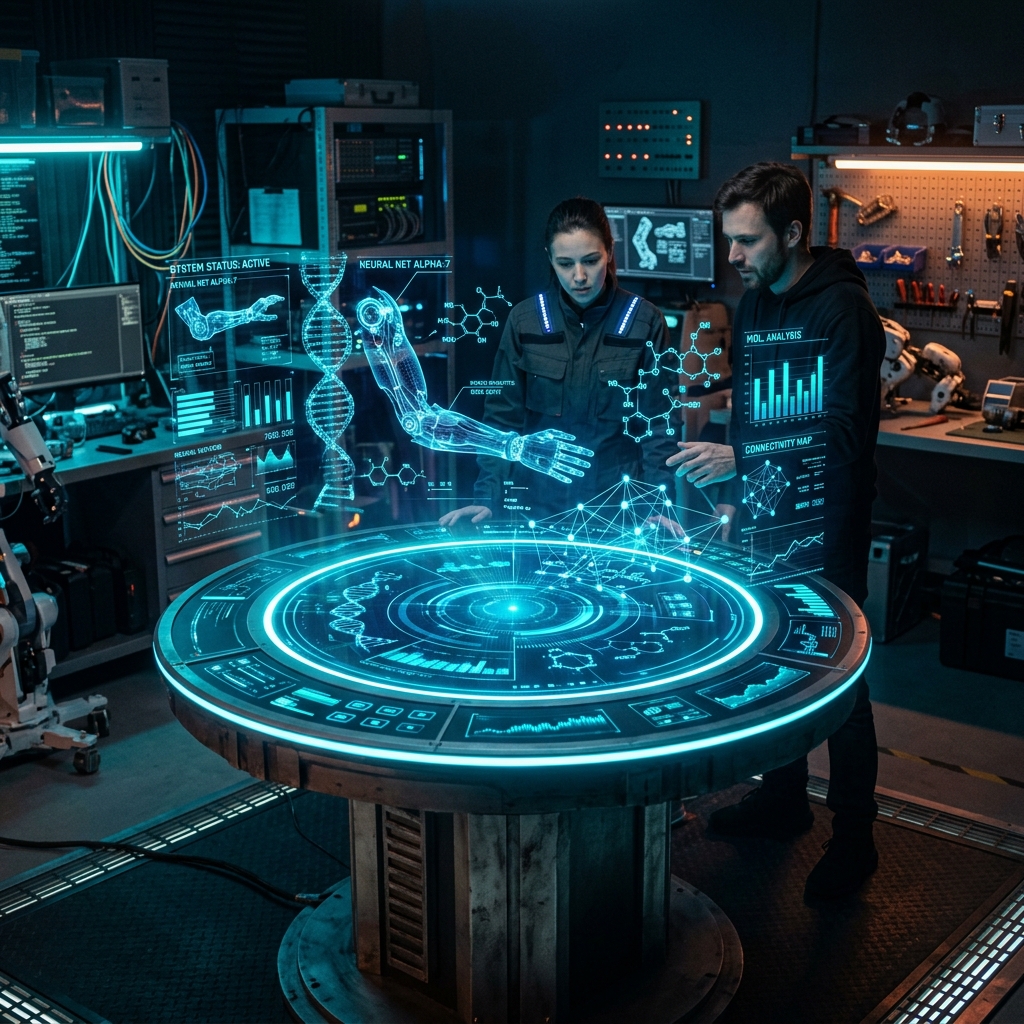
The Collaboratory is where labs intersect. Users can invite collaborators, co-build systems, propose revisions, test alternatives, and develop shared experiments together. The purpose of the Collaboratory is cooperative construction.
The Observatory
This is where work enters the public world.
Users can publish experiments, frameworks, essays, visual systems, research, creative works, simulations, or unfinished projects for others to explore. Others may observe, critique, reference, expand, or build upon what has been shared. The purpose of the Observatory is contribution.
The Core Unit: Experiments
Qettra does not revolve around posts. It revolves around Experiments.
An Experiment is any evolving unit of intellectual creation.
Unlike traditional static social posts, Experiments are living structures. They can evolve over time, remain unfinished, branch into alternatives, or combine with other work. They are designed to grow and endure.
What qualifies as an Experiment?
Thinking Has Multiple Modes
Strong ideas require both freedom and rigor. Qettra is designed around the reality that human thinking moves between multiple states.
Exploration: Possibility Over Perfection
Ideas begin uncertain.
At this stage, curiosity matters more than correctness. People brainstorm, speculate, sketch, experiment, question, and follow intuition. This mode prioritizes the open canvas, where raw ideas can live in their natural, messy, and creative forms.
- Brainstorming and speculation
- Intuition-driven sketching
- Welcoming of curiosity and messiness
Construction: Rigor Over Randomness
Ideas must eventually face structure.
This stage prioritizes rigor. Assumptions are clarified, systems are refined, and relationships between concepts become visible. Contradictions emerge and are resolved, allowing projects to become coherent enough to survive critical pressure.
- Clarifying and testing assumptions
- Structural mapping of relationships
- System hardening under pressure
Translation: Bridging Intuition & Implementation
Moving ideas from private minds to public spaces.
Many struggle to translate raw thinking into clean execution. Qettra bridges this gap. Messy ideas become structured systems. Technical models become accessible explanations. Research becomes visual, and frameworks become collaborative. Creativity and rigor are stages of the same process.
- Making research visual and accessible
- Structuring messy ideas into clear layouts
- Turning complexity into curriculum
Forking Instead of Arguing
Most online disagreement produces noise. Qettra encourages construction.
If someone disagrees with an idea, framework, or system, they can **fork the Experiment**. A fork creates a new version where assumptions can be changed, tested, expanded, or improved.
Instead of endless arguments, people build alternatives. Different approaches can be compared directly.
The question becomes: Not “Who is right?” But “What works better?”
Disagreement becomes productive, culminating in actionable intellectual creation.
Commons: Shared Spaces
Labs do not exist in isolation. Qettra includes shared spaces called Commons.
Commons are organized around domains, interests, and collaborative goals. Rather than endless feeds of disposable content, users encounter active projects, evolving systems, and people genuinely building things.
Explore Active Commons:
A Network for Builders
Qettra exists for people who want to think, create, and construct. It is not a platform for spectators.
The Long-Term Vision
The future will not be built by isolated specialists alone.
It will belong to people capable of collaborating across disciplines, translating complexity, and building together. Qettra exists to make that possible.
The internet gave humanity communication.
Qettra is designed to give humanity a place to think together.
Apply for Beta Access
Claim your Personal Lab and begin building. We are launching in batches.
A Different Kind of Social Platform
Most platforms are organized around identity.
Qettra is organized around work.
Qettra is social, but it organizes social interaction differently. People connect through projects, ideas, experiments, and shared curiosity, leading to unique interdisciplinary intersections.
The platform rewards contribution rather than performance. The goal is not to appear intelligent. The goal is to build something meaningful.